
💚 Your Information
Enter your details to calculate your BMR
💚 Your Results
Your metabolic rate and daily calorie needs
Introduction
If you’ve ever wondered why some people eat a lot but stay lean, while others gain weight easily even with smaller meals, the answer lies in BMR – Basal Metabolic Rate.
Your BMR (Basal Metabolic Rate) is the number of calories your body burns at rest to keep you alive — for breathing, blood circulation, and organ function. Knowing this number is crucial if you want to lose fat, gain muscle, or maintain your current weight.
That’s where a Body BMR Calculator comes in. Instead of manually calculating with formulas, you can use our online tool to get instant results. In this guide, we’ll explain everything about BMR, show you how it’s calculated, and demonstrate how to use it for your health goals.
What is BMR (Basal Metabolic Rate)?
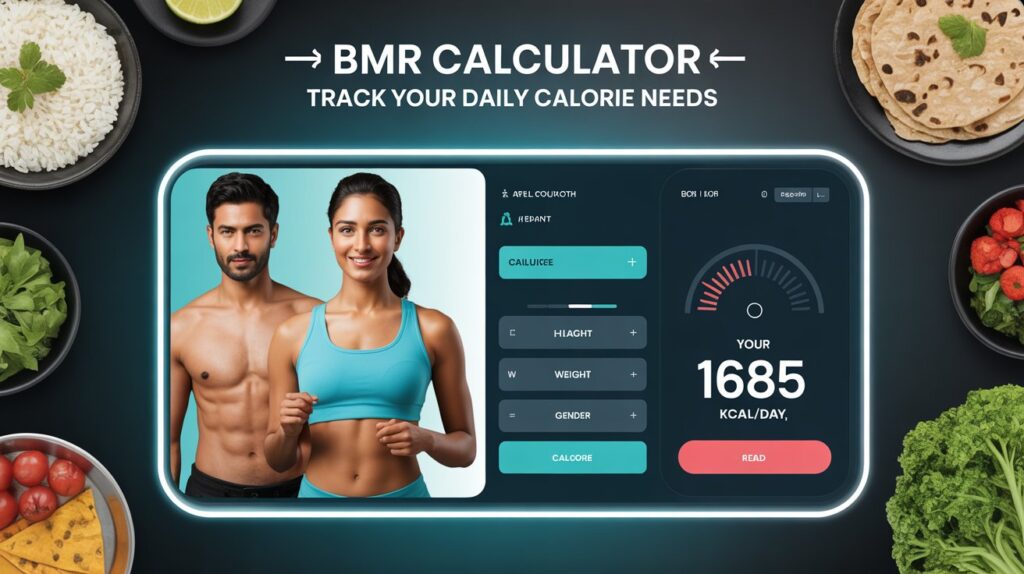
BMR is the minimum energy your body needs to perform vital functions at rest.
Even if you lie in bed all day doing nothing, your body still requires calories to:
- Keep your heart beating
- Support brain function
- Enable digestion and metabolism
- Maintain body temperature
- Keep cells and organs working
👉 Think of BMR as the “idle fuel consumption” of your body.
Why Use a Body BMR Calculator?
A Body BMR Calculator makes life easier because:
- It saves you from manual math using formulas.
- It shows you how many calories you burn daily at rest.
- It helps you determine your TDEE (Total Daily Energy Expenditure) by adjusting for activity.
- It gives you a starting point for diet planning (weight loss, maintenance, or gain).
- It works for everyone — men, women, athletes, office workers, students, etc.
How to Calculate BMR (Step-by-Step Formula)
There are several formulas used worldwide to calculate BMR. Let’s break them down:
Mifflin-St Jeor Formula (Most Common)
- Men:
BMR = (10 × weight in kg) + (6.25 × height in cm) – (5 × age in years) + 5 - Women:
BMR = (10 × weight in kg) + (6.25 × height in cm) – (5 × age in years) – 161
✅ Accurate and widely used for modern health & fitness calculations.
Harris-Benedict Formula (Older, Still Popular)
- Men:
BMR = 88.362 + (13.397 × weight in kg) + (4.799 × height in cm) – (5.677 × age in years) - Women:
BMR = 447.593 + (9.247 × weight in kg) + (3.098 × height in cm) – (4.330 × age in years)
✅ Slightly less accurate but still a valid reference.
Katch-McArdle Formula (Best for Athletes)
- BMR = 370 + (21.6 × Lean Body Mass in kg)
This formula works best for athletes and bodybuilders who know their body fat % and lean body mass.
Example BMR Calculation
Let’s calculate the BMR of an Indian male:
- Age: 25
- Weight: 70 kg
- Height: 175 cm
Using Mifflin-St Jeor Formula:
BMR = (10 × 70) + (6.25 × 175) – (5 × 25) + 5= 700 + 1093.75 – 125 + 5= 1673.75 calories/day
👉 His body burns ~1,674 calories daily at rest.
Factors Affecting BMR (Age, Gender, Weight, Lifestyle)
Your BMR is not fixed. It changes depending on:
- Age → Younger people burn more calories.
- Gender → Men usually have higher BMR than women.
- Weight & Height → Taller and heavier people have higher BMR.
- Muscle Mass → More muscle = higher BMR.
- Lifestyle → Sedentary vs active life greatly impacts calorie burn.
- Climate → Hot and humid regions (like India) can slightly increase BMR.
Body BMR Calculator for Men vs Women
- Men usually have higher BMR because of more muscle mass.
- Women typically burn fewer calories at rest, but activity and diet can balance this.
👉 Example:
- Male (70 kg, 175 cm, 25 years) → BMR ~1674
- Female (55 kg, 160 cm, 25 years) → BMR ~1350
Daily Calorie Needs Based on BMR (Activity Levels)
Your daily calorie requirement depends on your BMR + activity multiplier (TDEE).
| Activity Level | Multiplier | Example (BMR 1700) |
|---|---|---|
| Sedentary (little/no exercise) | 1.2 | 2040 calories/day |
| Lightly active (1–3 days exercise) | 1.375 | 2337 calories/day |
| Moderately active (3–5 days/week) | 1.55 | 2635 calories/day |
| Very active (daily intense exercise) | 1.725 | 2932 calories/day |
| Extra active (hard physical job + workouts) | 1.9 | 3230 calories/day |
👉 This tells you how much to eat for maintenance. To lose or gain weight, adjust calories by ±300–500.
BMR vs BMI – What’s the Difference?
- BMR (Basal Metabolic Rate): Calories your body burns at rest.
- BMI (Body Mass Index): A measure of weight vs height to check if you’re underweight, normal, overweight, or obese.
✅ BMR is about calories burned, BMI is about body fat assessment.
How Accurate is a Body BMR Calculator?
Online Body BMR Calculators are fairly accurate, but remember:
- They estimate based on formulas, not exact science.
- Accuracy improves if you know your body fat % (for Katch-McArdle).
- Lifestyle and metabolism differences mean results vary slightly.
👉 Use it as a guideline, not a strict rulebook.
Using BMR for Weight Loss, Gain & Maintenance
- For Weight Loss:
Eat 300–500 calories less than your TDEE. Focus on high-protein Indian foods like paneer, dal, eggs, sprouts. - For Weight Gain:
Eat 300–500 calories above your TDEE. Include calorie-dense foods like rice, ghee, nuts, milkshakes, parathas. - For Maintenance:
Match your calorie intake to your TDEE and balance it with daily activity.
Indian Diet Example Based on BMR Results
Let’s say your TDEE is 2200 calories/day. Here’s how it may look in an Indian diet:
- Breakfast (400 cal): 2 stuffed parathas + curd
- Mid-morning (200 cal): 1 banana + handful of almonds
- Lunch (600 cal): 2 chapatis + dal + sabzi + salad
- Snack (200 cal): Poha or upma with tea
- Dinner (600 cal): Rice + chicken curry/paneer curry + sabzi
- Evening snack (200 cal): Milkshake or fruit bowl
👉 Adjust quantities depending on your BMR & fitness goals.
Top FAQs on Body BMR Calculator
1. What does the Body BMR Calculator do?
It calculates your Basal Metabolic Rate (BMR) — calories burned at rest.
2. How do I calculate my daily calories from BMR?
Multiply your BMR by an activity factor (1.2–1.9) to get TDEE.
3. Is the Body BMR Calculator different for men and women?
Yes, formulas differ slightly to account for biological differences.
4. Can I rely only on BMR for weight loss?
No, use BMR + TDEE. Your daily activity is equally important.
5. How often should I check my BMR?
Update calculations when your weight, age, or activity level changes.
6. Does the calculator work for Indian diets?
Yes, BMR is universal. But we’ve added examples with Indian meals for accuracy.
7. Can BMR change over time?
Yes, muscle gain, aging, and lifestyle shifts can alter your BMR.
Conclusion
Your BMR (Basal Metabolic Rate) is the foundation of all health and fitness planning. With our Body BMR Calculator, you can easily calculate your daily calorie needs, adjust your diet, and work toward your weight goals.
Whether you want to lose fat, build muscle, or maintain weight, understanding your BMR + TDEE is the key.
👉 Start today — use our Body BMR Calculator and take the guesswork out of your fitness journey.